
Plymouth Homeowners Stay for 12 Years and 11 Weeks
But what is that figure hiding?
Walk down a Plymouth street and it is easy to assume that most homeowners have been there for years, or the home has been rented out for decades by a local Plymouth landlord. The gardens are established, the neighbours know one another and life carries on behind familiar front doors. Yet look at when those homes last changed hands and a rather different picture emerges.
Yet some Plymouth homeowners barely finish decorating before their next move. Others stay long enough to replace the same kitchen twice and watch a whole generation of neighbours come and go. That difference tells us something interesting about the Plymouth property market. It also helps explain why the decision to move or sell is rarely just about house prices.
How long do Plymouth homeowners stay?
I have been looking back through all the Plymouth property transactions in 2026, checking when homes last sold and how long their owners held them before selling again. Among the transactions analysed, the average gap between purchases and subsequent sales was 12 years and 11 weeks.
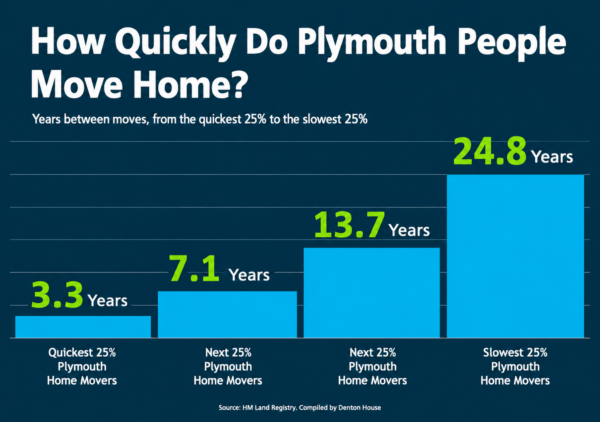
However, that single figure hides some very different moving habits. Divide those sales into four equal groups, from the shortest ownership periods to the longest, and the picture becomes much more revealing.
1. The quickest quarter of Plymouth home movers
For the fastest moving 25%, the average ownership period was just 3 years and 15 weeks.
Sometimes, life changes sooner than expected. A new job, a growing family or a relationship change can bring forward a move that was supposed to be years away. Others buy with a shorter stay in mind or are people doing the home up and selling it on quickly for a profit. Or perhaps the property is a first step onto the ladder and another bedroom is required sooner than expected! Either way, these Plymouth homes return to the market relatively quickly, creating buying opportunities for the next buyer.
2. The next quarter
The next 25% owned their homes for an average of 7 years and 5 weeks before moving.
That is enough time for a home that once felt ideal to start feeling a little less suitable. The spare bedroom becomes a nursery. The kitchen feels smaller. School catchments begin to matter. For some, the next move is about more space. For others, it is about finding a home that works better with the life they now lead.
Before we move on to the next group, it is worth looking at the first two groups together. They represent the fastest-moving half of homeowners in this analysis. They have an average ownership period of just 4 years and 49 weeks and have many things in common. Many of the properties in the fastest half are the sort of homes people buy early in their homeownership journey and tend to be flats, smaller semi-detached houses, townhouses and terraced homes.
Looking at the past eight years of UK data, a pattern emerges. Most homeowners move two or three times during their first 10 to 12 years on the property ladder as their circumstances and space requirements change. By their mid-forties though, they often settle into a home where they stay for decades.
3. Those who stay a little longer
The third group stayed for an average of 13 years and 36 weeks.
By this point, a house has usually become much more than somewhere to live. There are routines, friendships and memories attached to it. Children have grown older, working arrangements shift and priorities evolve. The property may still be much loved, even when it no longer quite fits.
4. The longest staying quarter of Plymouth home movers
The slowest moving 25% held their homes for an average of 24 years and 41 weeks.
These are the ownership periods that span whole chapters of family life. Children can arrive, grow up and leave home before the property comes back onto the market. Moving after that long is a substantial decision. It involves more than choosing another house. It can mean leaving familiar neighbours, established routines and rooms full of memories. Another large minority in this group of home sellers are Plymouth landlords exiting from the market.
The striking point in all of this is how different these four groups are. An average of 12 years and around 2 months for Plymouth homeowners cannot fully describe a property market where some owners sell after a couple of years while others stay for decades.
The same city, but very different reasons for moving
There is no single timetable for homeownership in Plymouth. One household might be planning its next purchase almost as soon as it moves in. Another may have no intention of leaving unless circumstances force the issue. Age and stage of life can play a part, but so can the suitability of the property itself. A home that continues to meet its owners’ needs gives them little reason to move.
That is why we should be careful about assuming that someone who has stayed for decades is simply waiting to downsize. They may be perfectly happy where they are. Equally, someone selling after a few years may be responding to an unexpected change rather than following a carefully planned climb up (or down) the property ladder. The transaction dates show us how long people stayed. They do not, on their own, tell us why they left.
The cost of moving home in Plymouth and the compromises of staying
Moving comes with a cost. Estate agency fees, legal costs, removals and, where applicable, stamp duty all need to be considered. Then there is the practical effort. Preparing a property for sale, arranging viewings, finding the next home and managing the move can make staying put feel considerably easier. It is understandable that homeowners sometimes decide to give it another year.
It also explains why 44% of UK homeowners surveyed by Zoopla recently had researched a move without telling their other half. I am sure you might have browsed homes for sale or checked their home’s value using on an online valuation tool. My advice to those quietly considering a move is to discuss your priorities and budget with everyone involved as it can help turn browsing into a plan that works for your household.
However, staying can involve compromises too. A difficult commute. Rooms that are rarely used but still need heating and maintaining. A shortage of space that creates the same frustrations every morning. Those compromises do not automatically mean moving is the right answer. They do explain why the conversation often begins long before anyone books a valuation. One evening, somebody in your home, and it could be you or your other half, looks around and asks, “Does this house still work for us?”
What this tells us about the Plymouth property market
We spend plenty of time discussing what Plymouth homes are worth in articles, yet how often they change hands deserves attention too. Every Plymouth property coming onto the market gives another household something to consider. It might provide a first purchase, room for a growing family or a more manageable home for someone ready to simplify their life.
The different ownership periods in this analysis show how those opportunities arise at different speeds. Some Plymouth homes return to the market within a few years. Others may be available only once in a generation. For buyers waiting for a particular street or type of property, that distinction can matter enormously.
It also explains why the local market cannot be understood through one average alone. Behind that figure are households making very different decisions, for very different reasons.
Is there a right time to move home in Plymouth?
These figures describe the homes that sold in the analysis. They are not a countdown for every Plymouth homeowner. Whether you have been in your home for five years, ten years or even thirty years does not mean it is time to leave.
The more useful question is whether your Plymouth home still suits your life. Does it give you the space you need? Is it in the right place? Does looking after it feel manageable? And if you were choosing a home today, would you choose this one again? For some Plymouth homeowners, the answer will be an immediate yes. Yet for others, that last question might take a little longer to answer. To find out how much your property is worth in today’s market, contact your local Julian Marks branch to book your free valuation. Julian Marks are Plymouth’s top-performing and most chosen estate agent, with 447 properties sold in PL1–PL9 over the last 12 months, more than any other agent and 54 more properties than our closest competitor. Data taken from TwentyEA on 19/11/26 for the period between 19/11/25 and 18/11/26. Julian Marks doesn’t just study these numbers. We use this deep local insight every day to get properties moved.